Monday, 13 December 2021

Groundswell of Support for Bongbong-Sara

Volume 3, Issue No. 17

OPINION/COMMENTARY
/ News That Fears None, Views That Favor Nobody /

. . . . . A community service of The Filipino Web Channel (TheFilipinoWebChannel@gmail. com) and the Philippine Village Voice (PhilVoiceNews@gmail.com) for the information and understanding of Filipinos and the diverse communities in North America . . . . . .
 
 Our latest as of Monday, December 13, 2021 

~ From surveys, news accounts, and film footages of their caravans, the groundswell of mass support appears genuinely spontaneous for the team of Ferdinand "Bongbong" Marcos Jr. and Mayor Sara Duterte, the candidates for president and vice president, respectively of the Philippines in the May 2022 elections. Collectively referred to by the people as BBM-Sara, the duo has been a megahit among voters despite opposition attempts to capitalize on their parents' alleged wrongdoings.


 . . . . . . . . . . . . . . . . . . . . . . . . . . . . . . . . . . . .  .


BBM-SARA ON THE MAY 2022 PHILIPPINE ELECTIONS
Their Team-Up Looks Like a Sure Winner


By ROMEO P. MARQUEZ
Editor, The Filipino Web Channel


“Elections belong to the people.” - Abraham Lincoln

TORONTO - Vlogs after vlogs after vlogs, the groundswell of mass support is recorded in high definition videos by hundreds of citizens and citizen journalists in cities and towns in the Philippines visited by candidates Ferdinand "Bongbong" Marcos Jr. and Inday Sara Duterte, the duo popularly called BBM-Sara.

He is running for president; she for vice president, in the May 9, 2022 elections. Four other candidates - current Vice President Leni Robredo, Senators Panfilo Lacson and Manny Pacquiao, and Manila Mayaor Isko Moreno - contest the top post. The winner will replace incumbent President Rodrigo Duterte who by law is termed out after six years in office. 

Watching extensive video coverage on social media alone, the turnout wherever they go around looks spontaneous despite claims and counterclaims that some candidates are paying off crowds to show up at motorcades and gatherings.

Elections are five months away but the beating of partisan political drums are getting louder and louder such as it has reached the Toronto western suburb of Mississauga where supporters of Ms. Robredo early this month undertook a motorcade of about a hundred cars, after which they held a one-hour program described by organizers as "packed with cheers".

The gambit, initiated by locals who hail from Bicol (the region Ms. Robredo comes from), may have been influenced by her low ratings, poor media positioning, and a series of critical gaffes that put into question her leadership and management competence. 

One survey by Publicus Asia Inc. published on Monday, December 13 in The Manila Times, showed that top contender Bongbong Marcos is way ahead of the pack while Ms. Robredo stays at a far distance.

"Over half of the respondents, at 51.9 percent, tagged Marcos as their preferred choice for president," the survey says. It was a 2.6 percent improvement from his previous score of 49.3 percent.

Compare that with Ms. Robredo's 20.2 percent and one can see why her supporters are drumbeating for her in every imaginable way, even here in Toronto. 

The rest of the presidential candidates received the worst, namely, Manila Mayor Isko Moreno at 7.9 percent; Senator Bong Go (who has already withdrawn), 3.9 percent; Senator Panfilo Lacson, 3.4 percent; and Senator Manny Pacquiao, 2.3 percent.

Marcos's running mate, Davao City Mayor Sara Duterte, daughter of President Duterte, was even more impressive. 

The presidential daughter was the choice pick of 54.8 percent of the respondents. Her opponents in the vice presidential race are equally in the doldrums, namely, Dr. Willie Ong at 11.2 percent; Senate President Vicente Sotto, 11 percent; Senator Kiko Pangilinan, 9.7 percent; and Lito Atienza, 1.5 percent.

The survey findings appear to confirm what the many different vlogs are showing - a groundswell of support for the BBM-Sara team.

Among those rooting for Ms. Robredo in the recent Toronto initiative were known fans of another Bicolana, Loida Nicolas Lewis, national chair of US Filipinos for Good Governance, based in Virginia. She recently coordinated an interfaith prayer zoom for Ms. Robredo and a Global Filipinos for Leni Summit 3. (Copyright 2021. All Rights Reserved).


Thursday, 9 December 2021

A Conversation with Maria Ressa

Volume 3, Issue No. 16

OPINION/COMMENTARY
/ News That Fears None, Views That Favor Nobody /

. . . . . A community service of The Filipino Web Channel (TheFilipinoWebChannel@gmail. com) and the Philippine Village Voice (PhilVoiceNews@gmail.com) for the information and understanding of Filipinos and the diverse communities in North America . . . . . .
 
 Our latest as of Thursday, December 9, 2021 

Editor's note: Maria Ressa, the newly-idolized "champion" of a free press per the 2021 Nobel Peace Prize, had been a colleague in the foreign press corps shortly before and during the ascendancy of Corazon Aquino to the Philippine presidency in 1986. She reported for CNN, a news competitor of DPA (Deutsche Presse-Agentur), the German news agency that had employed me for nearly two decades. From being an objective observer and chronicler, she's now emerged as a partisan, her views pretty much reflected in the kind of news reporting her social media outlet Rappler is engaged in. Not a few times was she caught lying, even propagating lies in the pursuit of her and her corporate partners' political agenda. 

Notwithstanding this known fact, and in the spirit of a free and untrammeled discussion, we yield this space to Carmen Nobel, Program Director of The Journalist’s Resource, the Harvard University-based website that aims to connect journalists with information about recently published academic studies. "The champion of press freedom shares insights for journalists who are fighting to hold power to account amid relentless harassment and misinformation on social media," Ms. Nobel writes in her intro. (The following article is republished with permission from The Journalist's Resource).


  . . . . . . . . . . . . . . . . . . . . .


FROM 2021 NOBEL PEACE PRIZE WINNER MARIA RESSA
How to Hold the Line: Four Journalism Survival Tips


By CARMEN NOBEL
Program Director, The Journalist's Resource


Nobel Prize winner Maria Ressa believes newsrooms around the world need to band together — and stop thinking of each other solely as competitors — in order to fight the good fight against misinformation. 

“We’re on the same side,” says Ressa, co-founder of Rappler, an independent Philippine news outlet known for its deep-dive investigations into the administration of Philippines President Rodrigo Duterte and the spread of online disinformation on social media. “If you are a news group, you are on the side of facts. I think we should be sharing each other. I think we should be working together — letting go of the old-school idea that everything is homegrown, that this is our brand. Because we’re in a battle for facts.” 
Ressa received the 2021 Nobel Peace Prize, along with Russian journalist Dmitry Muratov, “for their efforts to safeguard freedom of expression.” The Nobel committee noted the laureates “are representative of all journalists who stand up for this ideal in a world in which democracy and freedom of the press face increasingly adverse conditions.”  
For the past year, Ressa and Rappler have been fighting multiple court cases that threaten the future of the publication and Ressa’s personal freedom. In June 2020, she was found guilty of “cyber libel” for a story published on Rappler in 2012. Ressa was executive editor of Rappler at the time, but she neither wrote nor edited the story, which was published four months before Philippines’ cybercrime law even existed.
In general, laws can’t be enforced retroactively in the Philippines. But in 2014, Rappler corrected a typo in the 2012 story – changing the word “evation” to “evasion.” The Department of Justice decided this counted as a republication, and thus decided the story was published after the law went into effect. Ressa is appealing the case, and she implores journalists to keep holding the line for press freedom. 
“I appeal to you — the journalists in this room, the Filipinos who are listening — to protect your rights,” Ressa said in a press conference immediately following that ruling. “We are meant to be a cautionary tale. We are meant to make you afraid. So, I appeal again: Don’t be afraid. Because if you don’t use your rights, you will lose them. Freedom of the press is the foundation of every single right you have as a Filipino citizen. If we can’t hold power to account, we can’t do anything.”  
In early November, the Philippine Court of Appeals permitted her to travel to Harvard Kennedy School, where she is a Fall 2021 Hauser Leader at the Center for Public Leadership and a Fall 2021 Joan Shorenstein Fellow at the Shorenstein Center on Media, Politics and Public Policy — also home to The Journalist’s Resource. The same court granted her permission to travel to Oslo to receive her Nobel Peace Prize this week.
Before returning to the Philippines at the end of November, Ressa sat down with JR to share tips and insights for journalists who are fighting to hold power to account in the face of relentless harassment and misinformation on social media.
These are four key takeaways from our conversation.  

1. Online attacks are harmful to journalists’ mental health. Newsroom managers can help ensure journalists get the counseling they need, but professional counselors need to understand the specific needs of journalists.

Last spring, UNESCO published a discussion paper called “The Chilling,” a report of online attacks against women who are journalists, based on a book-length study by the International Center for Journalists. The research included a survey of 901 journalists from 125 countries; long-form interviews with 173 international reporters, editors, and press freedom and safety experts; and two case studies of attacks against women whose journalism has exposed problems with online platforms like Facebook — one focusing on Ressa, the other on Carole Cadwalladr, the British journalist who exposed the Facebook-Cambridge Analytica data scandal in 2018.  
Of the survey respondents who identified as women, 73% said they had experienced online violence (including misogyny and other forms of hate speech), 25% said they had been threatened with physical violence online, and 20% said they had been attacked or abused offline in connection with the online attacks they had experienced. Some 11% reported missing work to recover from online attacks and 2% quit journalism altogether. 
The case study on Ressa includes a big-data analysis of nearly 400,000 tweets targeting Ressa from December 2019 to February 2021, and more than 56,000 Facebook posts and comments about her, published between 2016 and 2021. The data shows that 60% of these online attacks seek to damage Ressa’s professional credibility — calling her a “fake news queen,” for example, or a “presstitute.” Some 40% are personal, including death threats and attacks on her personal appearance. 
“Name any animal, I’ve been called it,” Ressa said calmly during the 2021 Salant Lecture on Freedom of the Press  on Nov. 16, which was livestreamed internationally. “I have eczema, extremely dry skin — and the meme they created was ‘Scrotum Face.’” 
This is all to say that Ressa understands the importance of anticipating a harassment onslaught, the importance of transparently acknowledging personal and professional threats, and the importance of helping journalists deal with them. 
While Ressa gets the worst of it, she’s just one of many Rappler journalists facing a routine barrage of hate on social media. “When we all came under attack, we actually became better friends,” she says.  
A couple of years ago, the news organization actively started offering professional counseling for its reporters and social media team. “Because you’ve got to,” Ressa says. “You’ve got to take it home.” 
Asked whether anyone accepted the therapy offer, “Yeah, of course,” Ressa says. “But then, you know what we realized? That our counselors in the Philippines didn’t understand the impact of exponential attacks. So, we had to then go to Dart and ask them to train the trainers.” 
She’s talking about the Dart Center for Journalism and Trauma, which last summer launched the Journalist Trauma Support Network, a pilot program that teaches therapists about the types of trauma and harassment journalists encounter in the course of their work.  
Early in 2018, the Philippine government initiated multiple legal proceedings against Rappler, including revoking its operating license. Before holding a press conference to tell the world what was happening, the Rappler leadership team met with the newsroom’s reporters.  
“We held a general assembly among our people, and we flagged it for them,” Ressa says. “We’re walking into a different era and a different time. They’re actively trying to shut us down, and everyone is facing different risks. And we told them, ‘If you want to move to another news organization, we will help you.’ No reporter came to us. …Because when we were transparent and told them what to expect and gave them a choice, they committed even more.”  

2. In the battle against misinformation, journalists must promote and share the work of other journalists.

“The biggest shift in the world was that the creation of journalism was separated from distribution,” Ressa says, referring to the way information is spread on social media platforms. “And the principles of distribution allowed facts and lies to be [treated as] identical.” 
She notes that research indicates lies have a distribution edge on social media. In addition to citing reports that Facebook’s algorithms prioritize hateful messages, Ressa points to a 2018 study in the journal Science, “The spread of true and false news online,” in which researchers analyzed the spread of true and false news stories on Twitter from 2006 to 2017.  
The study finds that fake news stories were 70% more likely to be retweeted than real news stories, even when controlling for factors like the age of the Twitter account, the number of followers and followees of the original tweeter, and whether Twitter had verified the account with a blue check. 
“70% more,” Ressa says, her voice rising. “70% more! That’s part of the reason I think you need journalists all around the world to keep standing up to power. Now what we do have are standards and a mission. And courage. Because we’re foolish enough to keep standing up to power even at the detriment to the organization or to the journalist. So that’s what we have. But how can we then get the distribution? We should be thinking about strategies of distribution. So my solution to that is we should be sharing each other. That’s what is in our control, right?”  

3. For journalism to matter, journalists must empower the communities they serve. 

Rappler’s name combines the root words ‘rap’ (to discuss) and ‘ripple’ (to make waves).
“It was born to a new world of possibilities — driven by uncompromising journalism, enabled by technology, and enriched by communities of action,” reads the organization’s mission statement. “For journalism to matter, the community must be a part of it.” 
Ressa maintains that one the biggest and important challenges for news media outlets is to warn their readers, viewers and listeners about the dangers of misinformation on social media.
“How are you going to tell your communities that they’re being manipulated?” she says. “And how can you pull the community together? Think of it like this: If we’re prioritizing toxic sludge, if we’re prioritizing anger, hate, conspiracy theories — everything that feeds on your fear and your us-against-them — then you’ll also preclude the best of humanity, the miracle of how we do impossible things together. And that’s the opportunity loss that I see.
“I get emotional when I talk about this,” she adds, with tears in her eyes.
Ressa now spends more time focused on technology regulation and distribution issues than she does on reporting the news. “If I write something today, it will be about how tech and data are manipulating you, or how it is impacting the world today,” she says.

4. Accept that it’s a terrifying but vital time be a journalist. 

“We have to accept that in this time period, it will be thankless,” Ressa says. “We will be vilified. Everyone will attack us. But we must keep doing what we’re doing because no one else is doing it.”
According to data from the Committee to Protect Journalists, 1,421 journalists have been killed since 1992. And 274 journalists were imprisoned in 2020 alone. 
“You have to hold the line,” Ressa says. “The quality of the democracy is as good as the quality of the journalist. If the questions aren’t asked, then power gets away with what it wants.”  

To learn more: 

  • Frontline produced the documentary “A Thousand Cuts,” which follows Ressa as she navigates Duterte’s crackdown on the news media in the Philippines. You can watch it in full on YouTube.
  • In “The Chilling: Global trends in online violence against women journalists,” UNESCO presents an edited excerpt of a book-length study by the International Center for Journalists. The report begins with a quote from Ressa: “The easiest part is dealing with the impact of online violence and disinformation on me. I just see the impact on the world, and I don’t know why we’re not panicking.”  
  • The Journalist’s Resource recently published a list of self-care tips and resources for journalists who cover and experience trauma, featuring insights from Dr. Elana Newman, research director at Columbia University’s Dart Center.
  • Reporters Without Borders publishes an annual index ranking press freedom in 180 countries.  Norway tops the list for having the most press freedom in 2021, while Eritrea ranks last. The Philippines is 138th on the list. The United States is 44th.
  • Ressa was the featured speaker for the 2021 Salant Lecture on Freedom of the Press. The title of her talk: “What Would You Sacrifice for the Truth?” 
Program Director Carmen Nobel joined The Journalist’s Resource 
in 2018 after serving as senior editor of Harvard Business School 
Working Knowledge, where she covered economic research and
 forged content partnerships with QuartzForbesHBR Ascend 
and the World Economic Forum. Her work also has appeared in 
the Boston GlobeBoston MagazineInc., NPR Science Friday, 
PC MagazineeWeek and McSweeney’s Internet Tendency.

Wednesday, 8 December 2021

'Hands-Off Filipino Centre Toronto' Seems To Be the Norm

Volume 3, Issue No. 15

OPINION/COMMENTARY
/ News That Fears None, Views That Favor Nobody /

. . . . . A community service of The Filipino Web Channel (TheFilipinoWebChannel@gmail. com) and the Philippine Village Voice (PhilVoiceNews@gmail.com) for the information and understanding of Filipinos and the diverse communities in North America . . . . . .
 
 Our latest as of Wednesday, December 8, 2021 

~ The predicament the community is in requires the cooperation of the men and women who officiate the non-profit Filipino Centre Toronto. Without them loosening their grip on their heavily-guarded financial state, the community could not understand why support should continue when the organization withholds vital information from the general public. FCT's political backers in the Liberal caucus and the legally-impermissible Philippine diplomats in Ontario seem to be of no help in convincing the close-mouthed officers to practice the transparency and accountability they preach. 

 . . . . . . . . . . . . . . . . . . . . . . . . . . . . . . . . . . . .  .


FILIPINO CENTRE TORONTO SETS AN EXAMPLE
Have We Become a Community of Deaf-Mutes?


By ROMEO P. MARQUEZ
Editor, The Filipino Web Channel


"Speak the truth. Transparency breeds legitimacy." John C Maxwell


TORONTO - In two instances during the birthing process of what would become the multi-millionaire Filipino Centre Toronto (FCT), the Philippine government (PHL) made significant moves to bring it to life.

They are two separate, independent entities. While FCT carries "Filipino" in its corporate name, it is a Canadian non-profit. It simply means PHL or its agencies like the Philippine Consulate General Toronto has no jurisdiction over it because it is Canadian.

Notwithstanding the legal and diplomatic niceties, a Philippine ambassador to Canada and later a Philippine president unzipped their purses, took out $5,000 each, and gave the money to cash-strapped FCT.

The twin gestures seeded FCT sufficiently to convince the community to chip in their hard-earned resources for a cause they deemed worth supporting, i.e., to assist in funding FCT so it can buy a place that would house its programs and activities.

FCT's avowed goal, according to its website, is "to help Filipinos preserve their identity and individuality while at the same time making their presence felt in their new country". 

Indeed, Filipinos are "making their presence felt" in ways that seem to diminish our reputation as honest and reputable people, if and only if, we take FCT as our model. How FCT project that "identity" to the mainstream is problematic.

In December 2002 FCT acquired what its former president described as a "cockroach and mice-infested building" in downtown Toronto. No one probably knew that that characterization would later on be an appropriate basis for sizable money claims by the same person who had judged it and her partners.

A decade and a half later, that edifice was sold for $5.9 milion, and with that huge amount of moolah, it became FCT's rescuer from ruin. Ever heard of the adage "Where there is sugar, there are bound to be ants"? That's exactly the situation now at FCT.

More than a savior, the ill-fated clubhouse appeared to have morphed into a cash cow, a private treasury, an ATM if you will, by the stonefaced officers of FCT, namely, Mary Ann Juan, Efren de Villa, Theresa Lumanlan, Judith Gonzales, and Wendy Area, the president, chairman, vice president, secretary, and treasurer, respectively. Equally tightlipped are the dozen members of the board.

Soon after the money flooded FCT's new one-story digs in neighboring Scarborough, monetary claims materialized, and runaway spending and illegal payments to officers are alleged by members, concerned citizens, and whistleblowers. 

Related stories at the links below: 
1. https://filwebchannelmagazine.blogspot.com/2021/10/fct-opens-its-mouth-with-warning-to.html.
2. https://filwebchannelmagazine.blogspot.com/2021/11/is-third-party-audit-ongoing-at-fct.html
3. https://filwebchannelmagazine.blogspot.com/2021/09/writer-claims-fct-doctored-financial.html
4. https://filwebchannelmagazine.blogspot.com/2021/10/
5. https://filwebchannelmagazine.blogspot.com/2021/09/fct-officials-oppose-audit.html

If repeated efforts to let those officials talk and adhere to their pledge of transparency are exhausting, prying its vault open to see the whereabouts of the $5.9 million would be equally arduous, especially considering the not-too-subtle threat of a lawsuit hinted by FCT lawyers.

That leaves us with not much choice. The Philippine Consulate would not touch FCT nor the issues concerning to all. Understandably so because PHL is powerless in this regard. But . . .

It is my personal belief PHL or its representative in Toronto, Consul General Orontes Castro, could exercise some form of moral authority over FCT. Both institutions (PHL and FCT) serve the same constituency, namely,  Filipinos, Canadians of Filipino ancestry, and dual Filipino and Canadian citizens.

The seed monies provided to FCT by the then Philippine Ambassador to Canada, Francisco Benedicto, and former President Gloria Macapagal-Arroyo could be a basis for wielding such moral authority which, according to Wikipedia, "is authority premised on principles, or fundamental truths, which are independent of written, or positive, laws. As such, moral authority necessitates the existence of and adherence to truth".

I had sought the counsel of Consul General Castro three times, one in July, another in August, and still another in November. In his initial response to my questions, he stated that "the Philippine Consulate General does not have the legal standing or basis to raise questions on intra-corporate matters and corporate operation . . . "

Moreover, he explained: "As to the donation of former Philippine Ambassador Francisco Benedicto to the FCT, we could not find this on the records of the Consulate General". Be that as it may, the donation was so explicitly stated in the historical account of the now-deceased former FCT president Rosalinda C. Javier.

When confronted with existing records, Consul General Castro reiterated the consulate's earlier position that it "has no legal standing or basis to raise questions . . . " He emphasized that "The Philippine Consulate General's duty is primarily to unite and promote cooperation among the Filipino community in our jurisdiction, and to be generally neutral, impartial and balanced in our relations with the community".

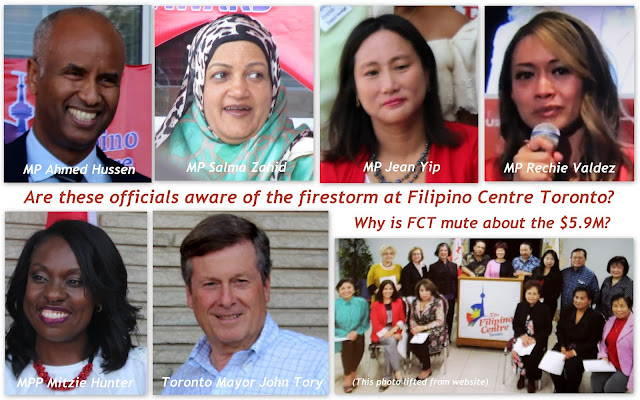
Faced with that blank wall again, I thought it would be wise to get comments from members of the Liberal caucus who frequented FCT events to show full and unquestioning support to FCT. I asked: "Are you aware of the firestorm at the FCT necessitated by its refusal to bare open how it's handling its millions?"

In my crosshairs were MPs Gary Anandasangaree, Salma Zahid, Ahmed Hussen, Shaun Chen, Rechie Valdez, and Jean Yip, MPP Mitzie Hunter, and Toronto Mayor John Tory. (Related story at: https://filwebchannelmagazine.blogspot.com/2021/11/why-is-fct-tongue-tied-about-its.html).

To this day, not one bothered to reply. Like the FCT, these federal, provincial, and city officials have turned mute. (Copyright 2021. All Rights Reserved).

Saturday, 27 November 2021

Why Is FCT Tongue-Tied About Its Millions?


Volume 3, Issue No. 14

OPINION/COMMENTARY

/ News That Fears None, Views That Favor Nobody /

. . . . . A community service of The Filipino Web Channel (TheFilipinoWebChannel@gmail. com) and the Philippine Village Voice (PhilVoiceNews@gmail.com) for the information and understanding of Filipinos and the diverse communities in North America . . . . . .
 
 Our latest as of Saturday, November 27, 2021 

~ The eye of the storm is In the Filipino Centre Toronto, a financially-robust non-profit that has barricaded itself from relentless public clamor to walk the talk of transparency and accountability in the management of its millions. Three years ago, it had members of the federal and provincial parliaments and Toronto city officials as guests to the inauguration of its new digs. Are these officials aware of the years-long raging storm within the organization that they keep praising?

 . . . . . . . . . . . . . . . . . . . . . . . . . . . . . . . . . . . .  .


IT'S ALL TALK THE TALK FOR YEARS
FCT Does Not Walk the Talk of Transparency


By ROMEO P. MARQUEZ
Editor, The Filipino Web Channel


"Where large sums of money are concerned, it is advisable to trust nobody". - Agatha Christie


TORONTO - As far back as 2019 when I began my newest blog - the Filipino Web Magazine (https://filwebchannelmagazine.blogspot.com/) - I've produced plenty of literature enough to give readers a pretty good perspective of Filipino Centre Toronto, its officers, and what that non-profit is all about. 

That blog and two others before it circa March 2010 (http://currentsbreakingnews.blogspot.com/) and November 2010 (http://torontonewsroom.blogspot.com/) are the online repositories of my newspaper and magazine articles, a hedge actually in case news sites get disbanded by their owners for whatever reason. 

They complement my top vlogs (The Filipino Web Channel, Currents & Breaking News Channel, Filipino Web Entertainment Channel, and Eats and Restos Channel) under the wing of my broadcast outlet Romar Media Canada. The four channels have combined subscribers of 11,148 and views of 6.672 million as of this writing.

A lot more of my stories had seen print but the digital version, including those in the mainstream news website Digital Journalism, had been archived or deleted without as much as a notice so I could have retrieved them. In fact, a local tabloid has purged its website of my major articles soon after my unceremonious departure.

The resort to blogging was compelling. I did not want to lose a beat as a community journalist. Rightly so, because many important events go unreported, ignored, or swept under the rug, for reasons attributable to a lack of concern, ineptitude, indifference, and personal attachments by the supposedly objective media.

Journalism is equally important as my advocacy for transparency among public officials, community organizations, and self-described leaders who take on the spotlight to promote themselves. I have no qualm presenting stories that some may view as offensive but that's exactly what investigative reporting is.

My professional and personal commitment is best exemplified in the stories I reported, some of which, in fact, had led to legal proceedings. Defamation lawsuits come with the territory. Many journalists see these suits as unavoidable risks when pursuing hot stories.

Yes, hot stories in the sense of exposé, meaning muckrake or the disclosure of scandals, frauds, and misconduct involving public officials and public figures. As an aside, I have devoted most of my time doing journalism tracking closely-guarded secrets and unlocking them for all to see.

Prior to this move to Toronto in 2010, I had documented all kinds of wrongdoing in the Filipino community in San Diego, California, my hometown for sixteen years, mostly in my own broadsheet newspaper. Once here, I continued the same kind of reporting that had put me in hot water at least four times.

No regrets though. The commitment stays strong, even if it looks like success in this one particular venture is not on the horizon, not for lack of trying but for the seeming indifference of the concerned people themselves. 

I honestly feel a creeping sense of failure in realizing one of many meaningful goals in my advocacy for transparency, which is to inculcate value in the community beyond the usual pomp and pageantry of faux crowns, glittering gowns, oversized sashes, and lavish galas.

That brings me to the Filipino Centre Toronto which has caught itself in the eye of the storm over its hardline stance to talk the talk but not walk the walk of transparency and accountability involving millions of monies in its possession.

No amount of convincing about the soundness of whistleblowers' demand for clarity can move FCT officials - Mary San Juan, president; Efren de Villa, chairman; Theresa Lumanlan, vice president; Judith Gonzales, secretary; Wendy Arena, treasurer; and its 12 directors, namely: Alvine Marasigan, Corazon Laraya Coutts, Frank Cruzet, Jerom Peralta, Lolit Tablang, Mercy Maliglig, Mhel Galleon, Nenette de Villa, Nitz Rejdik, Philip Beloso, Priscilla Tumulak, and Steffie Stephens. (Video at: https://www.youtube.com/watch?v=1dWabOiCwhU).

I wonder if its funders could move them, one way or another. I wonder if politicians we elect and compensate enormously and who make a show of public support for FCT like Gary Anandasangaree, Salma Zahid, Ahmed Hussen, Shaun Chen, Rechie Valdez, and Jean Yip could. I wonder if MPP Mitzie Hunter, Toronto Mayor John Tory, and some members of the City Council could.

I also wonder if they are all aware of the seething controversy in FCT. And if they knew, would they still praise FCT and its officers like they're benevolent gifts of humanity to the Filipino community? (Full story at: https://filwebchannelmagazine.blogspot.com/2021/10/fct-opens-its-mouth-with-warning-to.html).

One thing, however, is certain. Their presence at FCT functions, notably in August 2018 when it inaugurated its fixer-upper of a building bought for $1.9 million cash, has emboldened FCT to disregard demands to shed light on how it is spending the $5.9 million it gained from selling its old building in downtown Toronto. (Video at: https://www.youtube.com/watch?v=5MDQoagXLlQ).

Countless articles written by Maria CJ de Villa and Cress Vasquez published in some Filipino tabloids, and by this reporter that include videos, do not seem to make a dent on FCT's stone face and steel frame. They've even tightened the flow of information. (Video at: https://www.youtube.com/watch?v=E5YUCP0xqlQ).

They are a hardy lot, to say the least. No amount of exposé, critique, photographic and video revelation could sway the FCT people to unmute themselves. If they are not hearing-impaired, why are they tongue-tied? (Copyright 2021. All Rights Reserved).